The complete guide
AI for churches and nonprofits, without the hype.
Everything I've written about using AI in ministry and mission-driven work, in one place and in order: what it is, which tools to try, what never goes into them, and how to keep people at the center. Written for the team of one.


The short answer
AI is a tool. Your people are the point.
Artificial intelligence, for a church or a nonprofit, is software that can read, write, summarize, draw and reason well enough to produce a first draft of almost anything your team makes. It does not know your congregation, your donors or your mission. You do.
That's the whole frame. Every post in this guide comes back to it. Use AI for the temporary work: the first draft of the newsletter, the summary of the meeting, the graphic for Sunday, the research for the grant. Then spend the time you get back on the eternal work: the hospital visit, the phone call, the conversation in the lobby, the hour of prayer before you preach.
I teach this, week in and week out, to pastors, communicators, administrators and nonprofit teams: in workshops, in AI for Churches cohorts, and in a book of prompts written for church leaders. The posts below are what I keep coming back to. Automate the temporary. Invest in the eternal.
- 13 posts in the series so far, with two new ones every month
- 100+ trainings on communication, community & AI
- 35,000+ church communicators in the community I co-founded
-
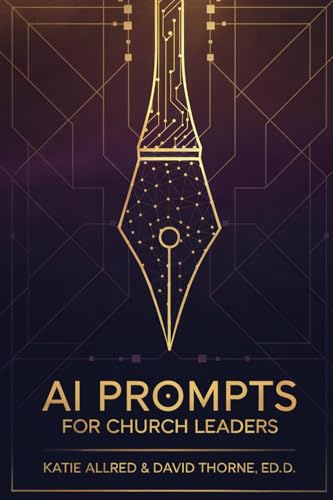 AI Prompts for Church Leaders
With Dr. David Thorne · 2025
Start here
Three posts, in order, if you're new to this.
Read these first. They take about twenty minutes together and give you the vocabulary for everything else on this page.
-
What Is AI and Why Should Your Church Care?
You're already using AI every day. A plain-language explanation of what AI is, how it learns, and why it matters for your church, no tech background required.
-
5 Ways Your Church Can Start Using AI Right Now
Don't know where to start with AI? Five simple ways your church can use it today: weekly communications, sermon research, graphics, grants and quick summaries.
-
ChatGPT, Claude, or Gemini: Which AI Tool Is Right for Your Church?
ChatGPT, Claude or Gemini? A plain-language breakdown of what each AI tool does best for churches, which one to start with, and what to know about privacy.
Three rules
What I teach every team on day one.
If your church or nonprofit remembers nothing else from this page, remember these.
-
Draft with AI. Decide as a human.
AI writes the first version. A person who knows your people reads it, fixes it and signs off. Nothing goes out, to the congregation or to a donor, that a human hasn't owned.
-
Nothing sensitive goes in.
Prayer requests with names, counseling notes, giving records, health details, anything about a minor. If it would hurt someone to see it leaked, it doesn't belong in a chatbot. Keep it in the systems built to protect it.
-
Tell people when AI helped.
A line in your policy and a habit in your team. Trust is the only currency a church or nonprofit really has, and honesty about your tools is how you keep it.
Free downloads
Three things to make this month.
Each one is the finished thing from a tutorial in the series, free with your email: a website you can have live this weekend, a policy you can sign on Tuesday, and a workshop you can run yourself.
-
A church website in an afternoon
A five-page starter site, the one-page brief that built it with AI, and how to publish it for free.
Get the website kit → -
The one-page AI policy
Six decisions with sample wording, church and nonprofit editions, fill in the blanks and sign.
Get the template → -
The 90-minute AI workshop
An agenda and worksheet so your team makes a page, a clip and a graphic in one sitting.
Get the worksheet →
Topic 1 of 6
What AI is and why it matters
Plain-language explanations for leaders with no tech background: what these tools are, what they're good at, and the first five things a church or nonprofit can do with them.
-
What Is AI and Why Should Your Church Care?
You're already using AI every day. A plain-language explanation of what AI is, how it learns, and why it matters for your church, no tech background required.
-
5 Ways Your Church Can Start Using AI Right Now
Don't know where to start with AI? Five simple ways your church can use it today: weekly communications, sermon research, graphics, grants and quick summaries.
Topic 2 of 6
Policy, privacy and governance
What belongs in an AI policy, what data never goes into a chatbot, how to talk to a board or elders about AI, and how to train a staff that is already using it.
Topic 3 of 6
Tools and prompts
Which tool to pick, how to write a prompt that actually helps, and what the image, audio and video tools can and can't do for ministry.
-
ChatGPT, Claude, or Gemini: Which AI Tool Is Right for Your Church?
ChatGPT, Claude or Gemini? A plain-language breakdown of what each AI tool does best for churches, which one to start with, and what to know about privacy.
-
The Art of the Prompt: How to Talk to AI So It Actually Helps You
Better prompts get better results. The anatomy of a great AI prompt, plus persona-based, iterative and meta-prompting you can practice this week at your church.
-
AI Image Tools Every Church Communicator Should Know
Create original church graphics in seconds. What DALL-E, Midjourney and Ideogram each do well, plus tips for getting better AI images for your ministry.
-
AI Audio and Video Tools the Church Should Be Experimenting With
AI now makes music, voices and video. What SUNO, ElevenLabs and HeyGen can do for your church, and the ethical questions to answer before you use them.
Topic 4 of 6
AI in ministry and communications
Sermon prep, newsletters, social posts, grants and the weekly grind: how a team of one gets time back without sounding like a robot.
-
Using AI to Write Sermons, Newsletters, and Social Posts Without Losing Your Voice
Worried AI will make you sound robotic? How to use it for sermon prep, newsletters and social posts as a starting point, and keep your voice your own.
-
How AI Can Help Your Church Comms Team Do More With Less
For the one-person church comms team: how AI can help with first drafts, sermon repurposing, brainstorming and proofreading, and the things it still can't do.
-
How to Use AI for Biblical Research and Sermon Prep (Without Losing the Spirit)
AI can't pray, but it can do hours of groundwork. How to use AI for Scripture study, sermon brainstorming and illustrations, plus one caution to keep.
Topic 5 of 6
Ethics, discernment and the human heart
Bias, deepfakes, misinformation and the things AI can't do: sit with the grieving, pray, or know your people. Why the church belongs in these conversations.
-
The AI Bias Problem: Why the Church Must Be at the Table
AI can be wrong in ways that matter to the church's mission. Where AI bias comes from, why it's an ethical issue, and practical steps your church can take.
-
Deepfakes, Misinformation, and the Church's Responsibility in the Age of AI
Deepfakes and misinformation spread fast in church group chats. What they are, why the church must respond, and why media literacy is discipleship.
-
AI Is a Tool, Not a Pastor: Keeping the Human Heart in Church Communications
AI can't sit with the grieving or pray with the hurting. Why the human heart still matters most in church communications, and what AI frees you to do instead.
Topic 6 of 6
What's next
Agentic AI, AI search and the changes coming to how churches and nonprofits are found, followed and run.
-
What Is Agentic AI and Why Should the Church Pay Attention?
Agentic AI is the next wave after ChatGPT. What makes it different from generative AI, what it could mean for churches, and what to watch for as it arrives.
For nonprofits
Same tools, different pressure points.
Everything above applies to a nonprofit team. The differences are where the pressure lands: grants, donors, impact reports, and funders who now ask how AI was used. Posts written with the development director and the executive director in mind carry a "nonprofits" tag.
Want help with this?
Reading is free. So is the first call.
When your team is ready to go from reading to doing, there are three ways I help.
-
Train your team
AI Basics is a 90-minute workshop for up to ten staff: how the tools work, a policy overview and a prompt starter kit. AI for Ministry adds a written policy, a custom prompt library and follow-up support.
See the AI training packages → -
Get a policy written
A ready-to-adopt AI usage policy for your church or nonprofit, covering staff and volunteer use, content creation and data privacy, delivered in about a week.
See AI Policy Writing → -
Learn at your own pace
Allred Academy is practical AI education for churches and nonprofits: courses and cohorts built from these same workshops.
Visit Allred Academy →
Questions
Questions I get in every workshop
What is AI, in plain language?
Software that has read a huge amount of text and learned to predict what comes next, well enough to write, summarize, answer questions and make images. Tools like ChatGPT, Claude and Gemini are the chat front doors to it. It is very good at first drafts and has no idea who your people are.
Is it okay for a church to use AI?
I think so, with guardrails. The church has used every medium of its time: Roman roads, the printing press, radio, the web. The question isn't whether to use the tool but how. Use it for the temporary work (drafts, summaries, graphics, research) so your people have more time for the eternal work: presence, prayer and care.
Which AI tool should our church or nonprofit start with?
Pick one, try it for a month, then try another; they all have free tiers. ChatGPT is the most popular and versatile, Claude is my pick for sensitive or complex writing, and Gemini fits a team that runs on Google Workspace.
What should we never put into an AI tool?
Anything you would be ashamed to see leaked: prayer requests with names, counseling and pastoral care notes, giving and donor records, health details, information about minors, and passwords. Use AI for drafting, brainstorming and research, and keep people's private information in the systems built to protect it.
Does our church or nonprofit need an AI policy?
Yes, even a one-page one. Your staff and volunteers are already using AI. A policy says what is encouraged, what is off limits, which data stays out, who reviews AI-assisted work, and when you tell people AI helped. Funders are starting to ask nonprofits for exactly this.
Can AI write a sermon?
It can do hours of groundwork: background on a passage, outlines to react to, illustrations to consider. The sermon itself, the prayer and the pastoral judgment have to be yours. Treat it as a research assistant, not a ghostwriter, and be honest with your congregation about how you use it.
Will AI replace church communicators and nonprofit staff?
It replaces tasks, not callings. The first draft, the caption and the summary go faster. Knowing your people, telling the truth well and sitting with someone in a hard week do not. Teams that learn the tools get time back for the work only people can do.
How is AI different for a nonprofit than for a church?
The tools are the same; the pressure points differ. Nonprofits lean on AI for grant research and drafting, donor segmentation and acknowledgments, impact reports and board materials, and they answer to funders who increasingly ask how AI was used. Churches carry more pastoral and theological questions. Both need a policy and a habit of human review.
How much does AI cost for a small team?
Most tools have a free tier that covers a small team's drafting and research. Paid plans are priced per person per month and add better models, more capacity and stronger privacy terms. The paid tier is worth it for anyone using AI daily, and the business or enterprise terms matter if you handle sensitive information.
Where should we start?
Read "What Is AI and Why Should Your Church Care?", then try the five uses in "5 Ways Your Church Can Start Using AI Right Now" with one tool for a month. When your team is ready to go further, the AI Basics workshop is a 90-minute start with a policy overview and a prompt starter kit.
Your people are the point. Let's give them your time back.
Book a free 30-minute call. We'll talk about where AI could take work off your team's plate, what should stay off limits, and where to start.
Book a free call →Heads up: As an Amazon Associate I earn from qualifying purchases. Buying through these links costs you nothing extra. Affiliate disclosure